
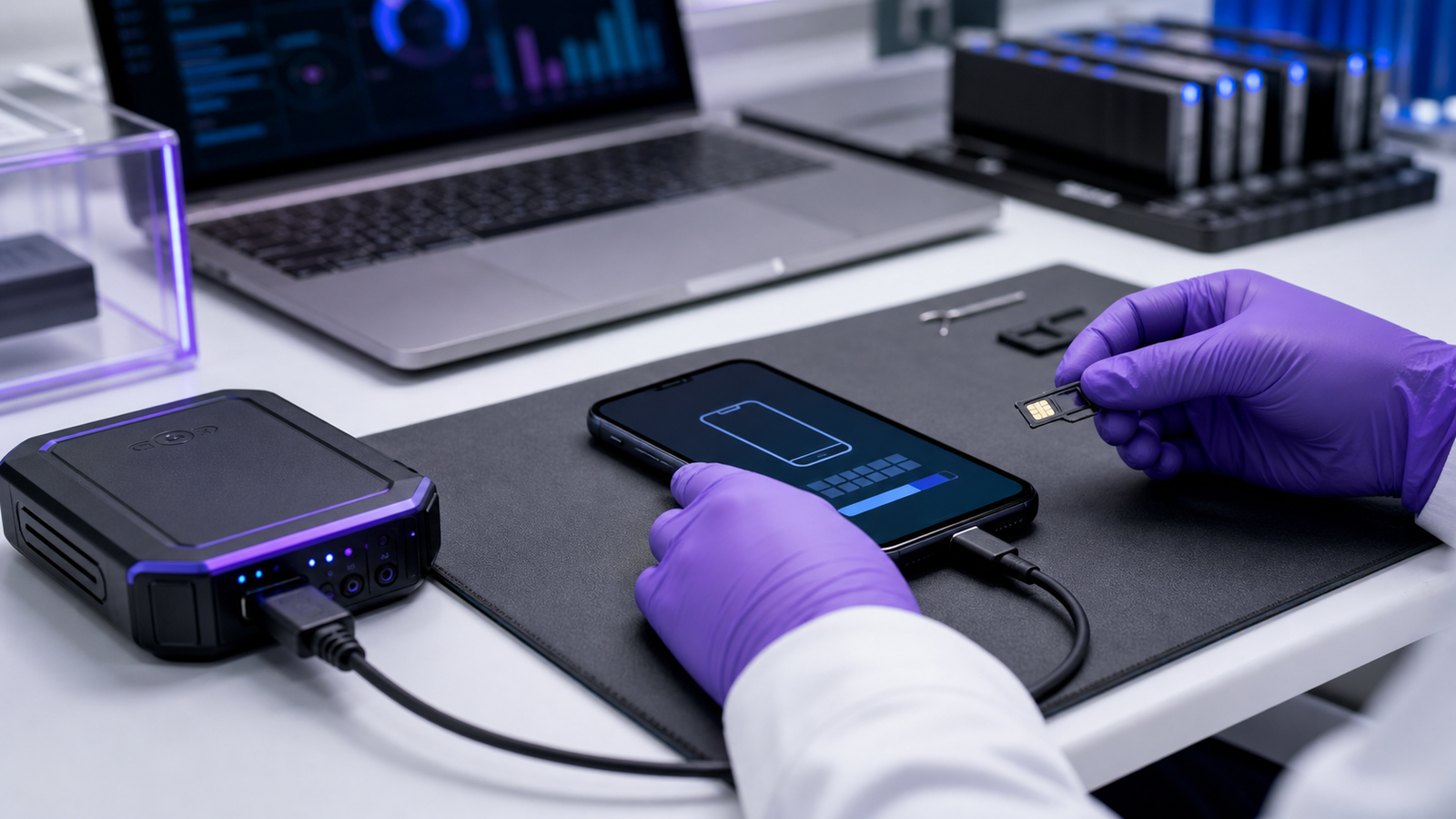
Why mobile evidence is different
A modern phone is simultaneously a computer, identity token, communications hub, sensor platform, cloud client, and gateway to other devices. Evidence may exist in application databases, system logs, notifications, temporary memory, SIM or eSIM information, synchronized cloud services, connected wearables, backups, and provider records. No single acquisition necessarily captures all of it.
The device is also dynamic. Incoming messages may alter databases, background services may rotate logs, remote management may lock or erase data, battery loss may change access conditions, and an application may expire content. This is why mobile forensic work begins with understanding the current state—not immediately connecting a tool.
What “volatile” means in a mobile investigation
Volatile evidence is information that may be lost or materially changed when power, connectivity, application state, or time changes. It can include active network connections, running processes, unlocked application state, transient notifications, current encryption keys, recently displayed content, and short-lived cloud or messaging artefacts.
Volatility creates a genuine trade-off. Keeping a device powered may preserve an unlocked state but also allows background change. Isolating it from networks may prevent remote interference but can affect application behaviour or access to synchronized data. There is no universal sequence that is safe for every device, platform, legal authority, and case objective. Trained personnel should make and document the decision.
Do not improvise on a live device. Preserve the scene, record the state, establish authority, and use a documented decision process appropriate to the device and investigation.
The first-response priorities
The first responder’s job is to protect options for the examiner. Before manipulating the device, record who found it, where it was located, date and time, physical condition, visible screen content, power and lock state, connected cables or peripherals, network indicators, and any immediate risk of remote action or data loss.
- Confirm legal or organizational authority and the permitted scope of collection.
- Photograph and document the device, screen, connections, accessories, and surrounding context.
- Record power, lock, airplane-mode, network, battery, notification, and application state without unnecessary interaction.
- Identify urgent volatility or remote-management risks and escalate to a qualified examiner.
- Begin a chain-of-custody record and use a unique evidence identifier.
- Package, transport, and store the device using a procedure appropriate to its state and investigative requirements.
Acquisition methods form a ladder—not a hierarchy of quality
Mobile acquisition methods offer different levels of access, risk, completeness, and repeatability. A backup or logical acquisition may efficiently recover user-visible records. File-system methods can expose richer application and system artefacts. Physical or hardware-assisted methods may recover lower-level data in particular circumstances. Live volatile capture can preserve state that a powered-down examination would lose.
More data is not automatically better evidence. The method should be proportionate to the investigative question and supported by authority, tool capability, device condition, time, and risk. Examiners should record the exact device identifiers, software and tool versions, acquisition method, start and end times, warnings, interruptions, output, and any changes the process may have made to the device.
| Method | Useful for | Key consideration |
|---|---|---|
| Manual documentation | Visible state and content when tooling is unavailable or inappropriate | Limited coverage and highly dependent on careful documentation |
| Logical or backup | Supported user data and application records | May omit deleted, protected, or lower-level artefacts |
| File-system | Application databases, metadata, and system artefacts | Access varies significantly by platform, version, and device state |
| Physical or hardware-assisted | Lower-level storage in supported circumstances | Greater complexity, risk, and interpretation requirements |
| Live volatile capture | Transient state that may disappear after lock, restart, or power loss | Collection itself can change a running system and must be documented |
Preserve integrity without overstating certainty
Integrity is established through process. Preserve the original output, calculate and record cryptographic hashes where technically meaningful, conduct examination on controlled working copies, protect access, maintain case notes, and retain tool logs. If a mobile acquisition necessarily changed some device data, the report should explain what changed, why, and whether it affects the interpretation.
Tools must also be understood, not merely trusted. NIST’s Computer Forensics Tool Testing programme exists because forensic tools need repeatable testing against defined functions. Laboratories should validate tools and workflows for their intended use, document known limitations, and have a process for changes in operating systems, device support, and tool versions.
Turn extracted data into an explainable finding
An extraction report is not the same as an investigative conclusion. Examination identifies and recovers relevant artefacts; analysis connects them to the case question, source, time, user, and surrounding evidence. Timestamps may reflect different time zones or application behaviours. Deleted or cached records may lack the context of a live record. Cloud-derived and device-derived versions may differ.
A defensible report separates observation from interpretation. It describes the device and authority, acquisition and validation methods, evidence identifiers, tools and versions, relevant artefacts, analytical reasoning, limitations, and the material needed for another qualified examiner to understand the work. For legal or regulatory matters, requirements should be confirmed with counsel and the relevant authority; technical guidance is not a substitute for jurisdiction-specific advice.
Standards and guidance
- NISTSP 800-101 Rev. 1: Guidelines on Mobile Device Forensics
- NISTComputer Forensics Tool Testing Program
- NISTQuick Start Guide for Populating Mobile Test Devices
This article provides general technical guidance and is not legal, regulatory, or case-specific advice.