
What makes a digital evidence process defensible?
A defensible process allows a qualified reviewer to understand what was collected, under what authority, by whom, when, using which method, how integrity was protected, what analysis was performed, which conclusions follow from the evidence, and which limitations remain. It does not imply that evidence is automatically admissible or immune from challenge; those determinations depend on jurisdiction, purpose, procedure, and the decision-maker.
Defensibility rests on four qualities: traceability from source to conclusion, integrity of preserved material, repeatability of method where technically possible, and explainability of judgement. Each quality must survive staff changes, tool updates, time, and independent review.
1. Establish authority, scope, and purpose
Before collection, document the legal, contractual, policy, or incident-response authority supporting the work. Define the devices, accounts, systems, data classes, custodians, time period, and investigative questions in scope. Identify privacy, privilege, cross-border, employee, customer, regulated-data, and third-party considerations with appropriate counsel or authority.
Scope should be specific enough to guide proportional collection but flexible enough to handle an authorized escalation. If the team discovers evidence outside scope, pause and follow the documented process for obtaining direction. Technical access is not the same as authority to collect or examine.
2. Make collection observable and traceable
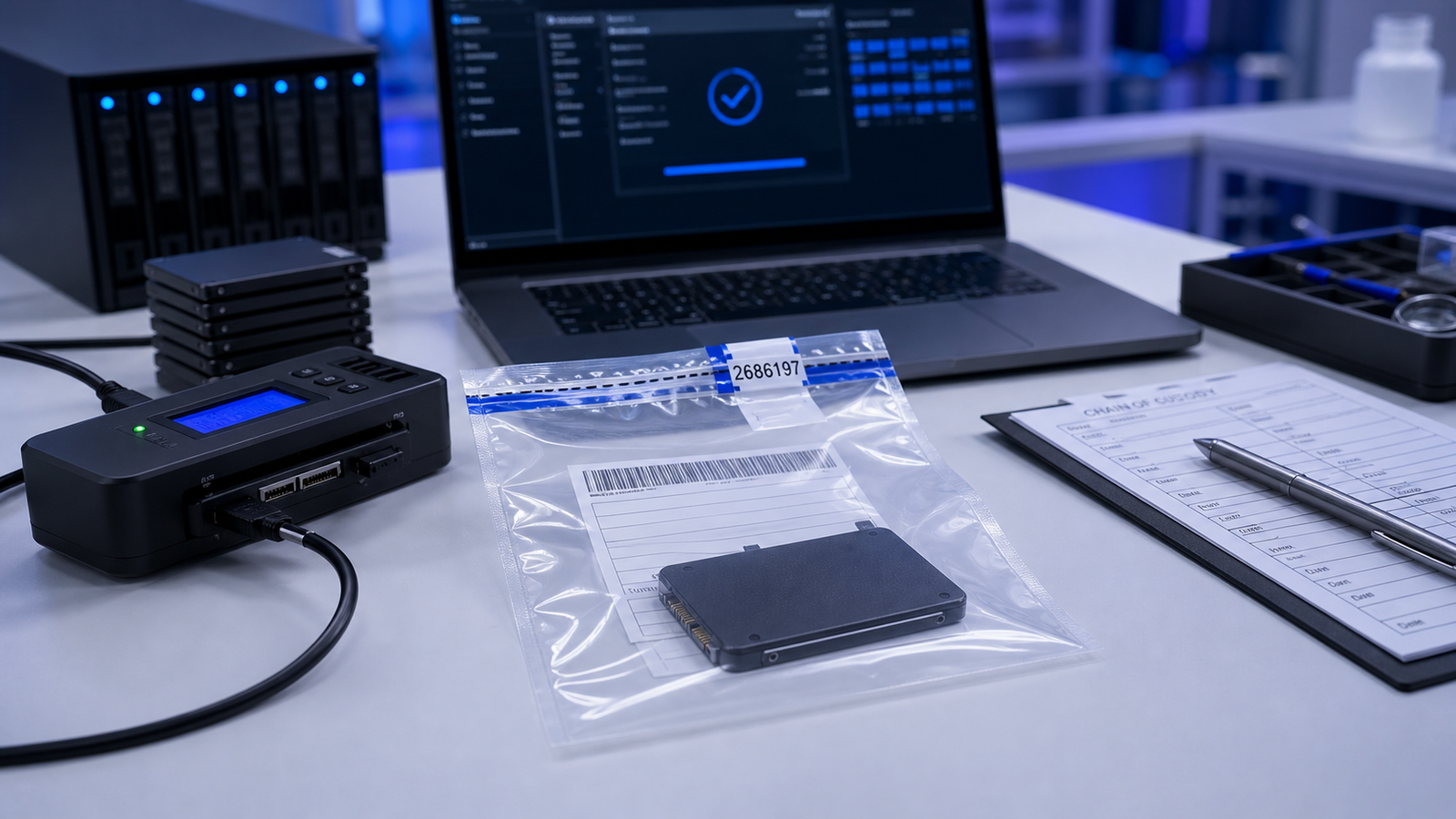
Assign a unique evidence identifier and begin contemporaneous notes at first contact. Record source, owner or custodian, location, date and time, device state, identifiers, connections, visible conditions, collection personnel, tools and versions, commands or methods, warnings, interruptions, and resulting outputs. Photographs and system-generated logs should support—not replace—the examiner’s notes.
- Confirm authority and record the approved scope and collection objective.
- Document the original state before avoidable interaction.
- Use a method appropriate to volatility, technical constraints, risk, and investigative need.
- Record time sources and time-zone assumptions for systems and examiner notes.
- Capture tool output, logs, errors, warnings, and any known changes made to the source.
- Transfer evidence using documented packaging, transport, storage, and access controls.
3. Preserve integrity and maintain chain of custody
Preserve original acquisitions in controlled storage and perform examination on verified working copies where possible. Record cryptographic hashes for files and images when they meaningfully demonstrate that a copy has not changed. A hash is one control within a larger process; it does not establish who collected the evidence, whether the acquisition was complete, or whether the method was appropriate.
The chain-of-custody record should identify every transfer or access event, including person, date and time, purpose, source and destination, and acknowledgement. Technical access logs can strengthen the record, but the process should remain understandable without relying on a single platform.
Integrity is not “the evidence never changed.” Some live and mobile acquisitions necessarily interact with a running system. Defensibility requires explaining and bounding that change.
4. Validate tools and understand their limitations
Forensic tools should be tested for the functions and environments in which they will be used. NIST’s Computer Forensics Tool Testing programme develops specifications, procedures, criteria, and test sets because reliable results require more than vendor reputation. Validation should address the relevant tool version, operating environment, target type, function, expected result, known limitations, and change-management process.
Maintain validation records, reference datasets, test results, tool and dependency versions, licensing status, and the conditions under which additional verification is required. Where practical, corroborate important findings through an independent artefact, method, or tool. When results conflict, document and investigate the conflict rather than selecting the preferred output.
5. Separate examination, analysis, and interpretation
Examination exposes and organizes artefacts. Analysis evaluates their significance against the investigative question. Interpretation explains what the findings support and what they do not. Keeping these stages conceptually separate helps prevent a theory from driving selective collection or overconfident conclusions.
Maintain an analysis log that connects each material conclusion to evidence identifiers, artefact locations, queries or methods, time normalization, assumptions, and corroborating or contradictory evidence. Distinguish user activity from automated system activity, record creation from later access, device time from server time, and absence of evidence from evidence of absence.
6. Report so another qualified person can follow the work
A report should identify the request and scope, authority provided to the examiner, evidence received, acquisition and preservation methods, integrity controls, tools and versions, examination steps, relevant findings, analytical reasoning, limitations, and disposition of evidence. Use plain language for decision-makers while retaining enough technical precision for review.
Avoid claims that exceed the evidence. State confidence and alternative explanations where material. Explain gaps caused by encryption, unsupported devices, missing logs, cloud retention, damaged media, overwritten data, time uncertainty, or tool limitation. Attachments and machine-generated reports should support the narrative rather than replace it.
7. Build quality assurance into the workflow
Use technical and editorial review proportionate to the matter. A reviewer should verify scope, evidence identifiers, integrity records, critical methods, calculations, timestamps, cited artefacts, limitations, and whether conclusions follow from the documented evidence. Material corrections should be traceable rather than silently overwritten.
After a case, capture lessons about tool behaviour, collection gaps, access delays, data retention, documentation, and coordination. Update procedures, training, validation, and readiness. A defensible process is not static; it becomes stronger as the organization turns each investigation into evidence about its own quality system.
Standards and guidance
- NISTSP 800-86: Guide to Integrating Forensic Techniques into Incident Response
- NISTComputer Forensics Tool Testing Program
- NISTSP 800-101 Rev. 1: Guidelines on Mobile Device Forensics
This article provides general technical guidance and is not legal, regulatory, or case-specific advice.